
Niagara County Previous Residents Eras
Work back from the address record that is closest to the period being investigated. A current PROS-GAR parcel card can supply a stable parcel key and a sale reference. Recorded instruments in SearchIQS take the ownership trail further back. Directories and census records can add a dated household view, while probate, obituary, and family files may explain the transition after a death. No one source lists every previous resident of a Niagara County address.
| Source | Years | Where Held | What It Shows |
|---|---|---|---|
| PROS-GAR parcel card | Current assessment view with historical sale/deed references | Niagara County Real Property | Parcel owner field, mailing address, SBL/SWIS, prior owner, sale and deed reference |
| SearchIQS deed index | Circa 1918 or circa 1941 onward for deeds, depending on the conflicting availability materials | SearchIQS and County Clerk | Recorded-instrument finding aid, subject to login and series/image coverage |
| Lockport city directories | 1856–57; 1859–78; 1880–85; 1887–1949; selected later runs through 1991 | NYS Library and Lockport Public Library | Dated printed address, name, and sections available in the particular volume |
| Niagara County directories | Selected years from 1869 through 1942 | NYS Library and local collections | County and community snapshots, with gaps between observed volumes |
| Federal and New York census | Federal 1820–1930 except 1890; 1940 and 1950 online; NYS 1855, 1865, 1875 | Lockport Public Library and public digital sources | Household composition and location evidence for the census date |
| FamilySearch miscellaneous/index material | Material 1821–1901; index 1800–1936 | FamilySearch catalog and access locations | Historical finding aids and related material, subject to access rules |
The recorded document trail is usually the starting point for ownership. Use the NYS Library holdings and census schedules only after choosing a target year. An old directory citation shows a printed snapshot, not a claim that the same name remained at the address before or after that issue.
Niagara County Parcel Records
Niagara County PROS-GAR is the practical first stop for an address. Its parcel card can bring together an owner field, correspondence address, prior owner, last-sale and deed reference, property description, assessment information, and map controls. Copy the SBL and SWIS before leaving the card. Those identifiers help connect a present-day street address to a parcel even when older documents use a lot, subdivision, or legal description.
An assessment owner field does not prove occupancy, title, or a full household. A prior owner field and sale history are leads to a recorded transaction. The County Clerk, not the parcel card, handles deed and title questions. If a municipal assessment issue is involved, the appropriate city, town, or village assessor can be the better contact.
Niagara County Deed Records
A deed chain follows the property and the recorded transaction, not a person’s later whereabouts. Start with the current parcel record and proceed from its sale/deed reference. The legal description, parcel map, lot or subdivision details, SBL, and instrument references matter when street wording changes. They are more dependable than trying to match a historical address by text alone.
- Find the parcel in PROS-GAR and record its SBL/SWIS, current owner field, last-sale reference, and legal-description clues.
- Look for the purchase deed in SearchIQS when the relevant series and image are available, or request it from the County Clerk.
- Read the seller, or grantor, and the legal description in that deed. Preserve the book/page or instrument number with the record date.
- Search that seller as a prior grantee to locate the earlier acquisition, then repeat the same document-to-document handoff.
- When online coverage ends, use Clerk volumes, FamilySearch catalog material, microfilm, the Historian, or a library repository instead of inferring a missing transfer.
- Grantor / grantee
- The grantor transfers an interest in a recorded document; the grantee receives it. The roles identify a transaction, not necessarily a person’s residence.
- Chain of title
- The sequence of recorded transfers and related instruments used to follow an interest in a parcel backward through time.
- Legal description
- The land description in a deed, often using lot, subdivision, metes-and-bounds, or map references. It can keep the trail intact when an address label is not stable.
The County Clerk’s records page is the official route for recorded documents and copies.
The Clerk route is where the parcel’s deed reference becomes a request for the actual recorded document or an available image.
Niagara County SearchIQS Records
SearchIQS presents a login and subscription landing page, and its result access and images vary by record series. The deed starting point is not settled by the public materials: an official index PDF reports deed coverage circa 1941, while SearchIQS help material reports circa 1918. Treat both as possible starting points, not as a promise that a target deed is online. Confirm the applicable cutoff with the County Clerk before drawing a conclusion from an empty search.
The same distinction applies to index data and images. A document may be indexed without a viewable image, and a particular series can have a separate image period. Mortgages are shown from January 2, 1963 in the availability material, while other record types have their own dates. A search result is a finding aid; the image or Clerk copy is the document to examine.
The SearchIQS Niagara County help page is the source of the circa-1918 description that conflicts with the official index material.
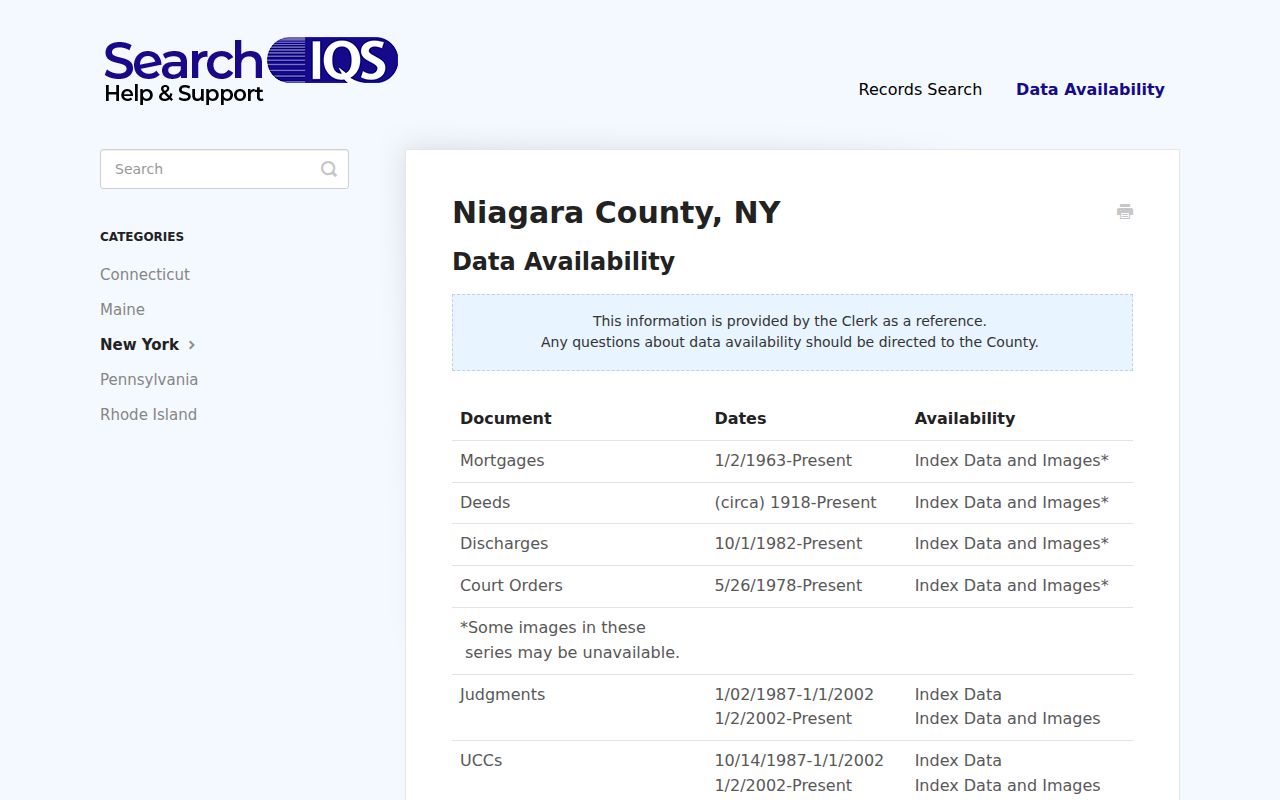
Record the source and the stated range in research notes so a future Clerk response can resolve, rather than hide, the discrepancy.
Niagara County Clerk Records
The Clerk’s deed information page explains the office’s role with recorded land documents. For a copy request, supply the parties’ names, recording date, and book/page or instrument number whenever possible. The request instructions warn that missing identifying details can prevent fulfillment. Copies of deeds, mortgages, maps, and related land records can be requested by phone, email, mail, or in person.
Specify whether the need is an index entry, a plain copy, a certified copy, a map, or a document image. SearchIQS does not make every older volume or image available. The Clerk’s physical material, FamilySearch catalog material, microfilm, the County Historian, and local libraries are the appropriate fallback routes for a real gap.
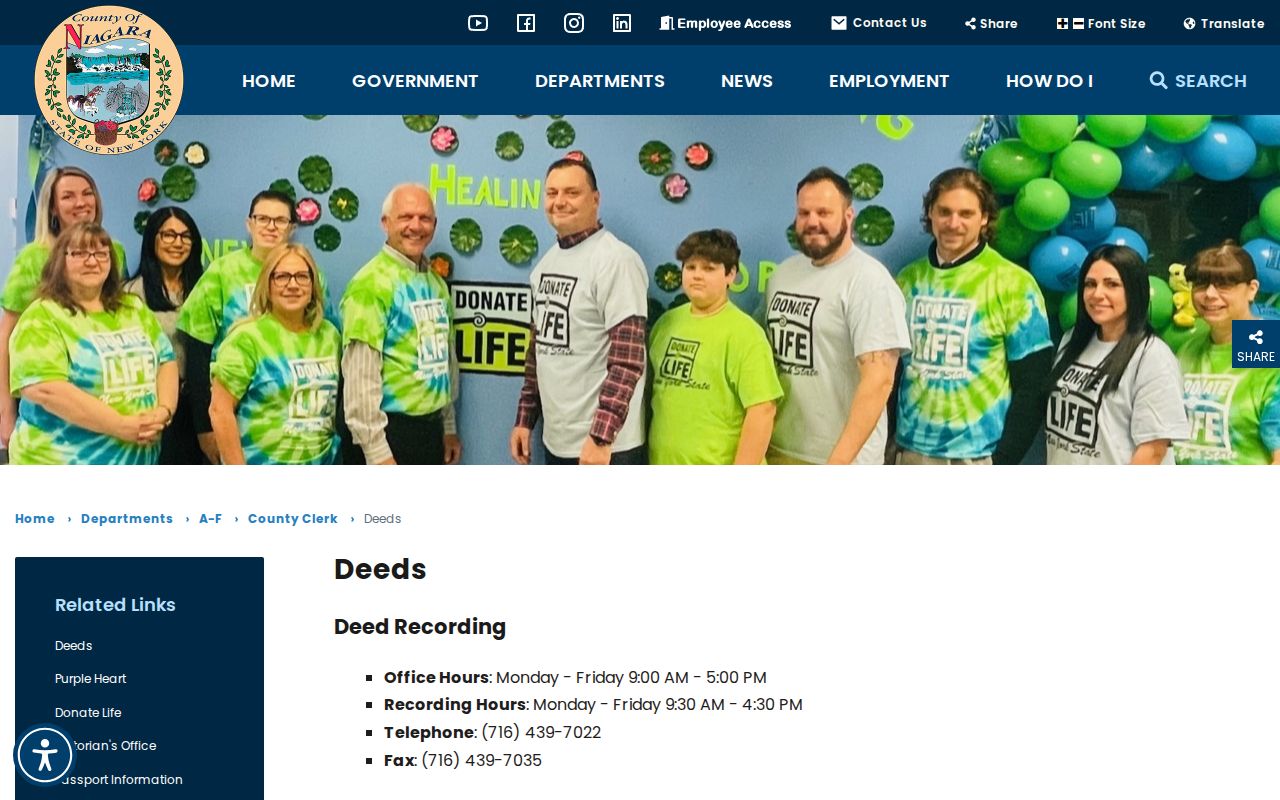
Bringing the book/page or instrument number from the parcel or index into the request reduces ambiguity and keeps the address history tied to a specific record.
Niagara County Previous Resident Directories
Previous residents are often found by pairing a directory issue with the nearest available census and then testing the address against the deed timeline. The historical collections are different sources with different dates. Niagara County directory collections provide the repository context; for one-address research, the key is to make the time sequence explicit.
- Choose the deed transfer or other dated event that creates a time window for the address.
- Find a directory volume within that window and use its street section if the volume includes one. Preserve the volume year and printed address exactly.
- Compare the name and address with the closest federal or New York census record, noting the census date rather than treating it as a continuous record.
- Use an obituary, newspaper, church, or family file only as another dated clue, then return to the deed or parcel identifiers to test the location.
Lockport Public Library lists city directories, newspapers, yearbooks, U.S. and New York census microfilm, an obituary index, and local-history-room service. The County Historian lists directories from 1856 as well as obituaries, census, naturalizations, church, veteran, map, newspaper, and family files. Those collections help corroborate a timeline, but none is a single complete register of every past resident.
Niagara County Directory Gaps
New York State Library holdings show why a historical address trail cannot be filled in year by year. Lockport directories are observed for 1856–57, 1859–78, 1880–85, 1887–1949, then selected runs through 1991. Countywide directories are observed for selected years beginning in 1869 and continuing through 1942. The missing intervals are part of the evidence, not permission to interpolate an address or name.
A separately cataloged Niagara criss-cross or reverse-directory run was not confirmed in the research. Search the street section of an ordinary directory when present, then ask Lockport Public Library or the Historian whether a reverse directory, telephone book, map, or local address index covers the chosen year. Exact Niagara Sanborn coverage and a public house-history guide also were not confirmed, so neither should be assumed in an address workflow.
Niagara County Probate Records
When a deed trail reaches an estate, an obituary, church record, directory, census, and probate file may explain a change in the address history. The Niagara County Surrogate range located in the genealogy guide begins in 1821. For 1808–1821, related probate material is associated with Erie County. That jurisdiction change is important when an early search in Niagara does not find the expected file.
FamilySearch catalog material includes miscellaneous records from 1821–1901 and an index range of 1800–1936, subject to its access conditions. The County Historian, Niagara History Center, and local libraries can help identify the right series. A name match is only a lead; compare dates, relationship clues, legal description, and municipality before attaching it to a particular address.
Niagara County Previous Resident Limits
A street address is useful but not permanent evidence. No official countywide street-renaming or readdressing list was located, so confirm any claimed address change with the relevant municipality. Older documents may use a legal description, lot, subdivision map, or a different municipality label. Follow the parcel’s SBL/SWIS and the legal description instead of forcing a textual address match.
A deed identifies parties to a recorded transaction, not every person who lived at the location. A directory and census are dated snapshots. A later address for a seller is not supplied automatically by the deed. Keep a separate note for the record type, date, source, exact search key, and remaining uncertainty.
Lawful use. Research about previous residents belongs in house history, family history, and personal curiosity. Do not use an old address, a deed, or a directory entry to stalk, harass, track, intimidate, or harm a living person.