
Niagara County Street Directory Search
A street-by-street search works best when it starts with a precise address rather than a name alone. First confirm the postal form and the municipality, because a mailing-place name and a town, city, or village are not always the same thing. Then use Niagara County PROS-GAR to resolve the address to a parcel. The resulting SBL and SWIS are steadier handoff details than a street label when an address is incomplete or has changed in how it is written.
- Enter the number and street name in Niagara County PROS-GAR. If several partial matches appear, add the municipality or use Street Finder before choosing a parcel.
- Copy the parcel’s address, SBL, SWIS, and any sale or deed book/page reference. Keep the exact spelling and unit with the search notes.
- Open the same address or SBL in the county GIS viewer. Inspect the parcel popup and nearby parcel boundaries one at a time instead of assuming adjacent lots share a number.
- Use the recorded deed reference to search SearchIQS or ask the County Clerk for a copy. A deed identifies parties to a transaction and the legal description.
- For an older address question, compare the date with a directory street section, census material, or the Historian’s local files. Those sources are historical snapshots, not a statement about a person now.
The state voter service is an individual registration and poll-service lookup, not a browseable street roster. Full voter-file requests have a New York elections-purpose restriction. That makes the parcel-to-deed path the reliable starting point for a street directory question, with historical collections used only for the period they actually cover.
Niagara County Street Directory Fields
Niagara County PROS-GAR’s quick search accepts several ways to identify the same parcel. It is designed for assessment and parcel research, not a complete resident list. The address tip calls for a street number and name without a suffix, and partial matching is supported. A number from a tax bill can be entered as the tax-map or SBL value. Owner search is shown as Last, First, with =Williams as the portal’s example of an exact last-name search.
| PROS field | How it works | Why it helps a street search |
|---|---|---|
| Address | Text, number and street name without suffix; partial matching is supported. | Best first step when a full address is known. |
| Tax Map # / SBL | Text from a tax bill or parcel record. | Retains the parcel connection when street wording differs. |
| Owner Name | Last, First; current and prior-owner matching is described. | Helps locate the recorded owner field after a parcel is identified. |
| Street Finder | County public-road selector, usable with a number. | Helps narrow an address when spelling is uncertain. |
| Municipality | Select menu for the local jurisdiction. | Separates similarly named places and roads. |
Use the advanced form only after the parcel is narrowed. Its observed filters include municipality, neighborhood, street name, property class, house style, condition, basement, waterfront type, and ranges for sale date, square feet, year built, sale price, assessed value, bedrooms, and bathrooms. A blank sale price does not establish anything about a person or a transaction; the portal notes that it can mean the sale was not considered arm’s-length.
The quick-search form shows the address, SBL, owner, street, and municipality controls discussed above.
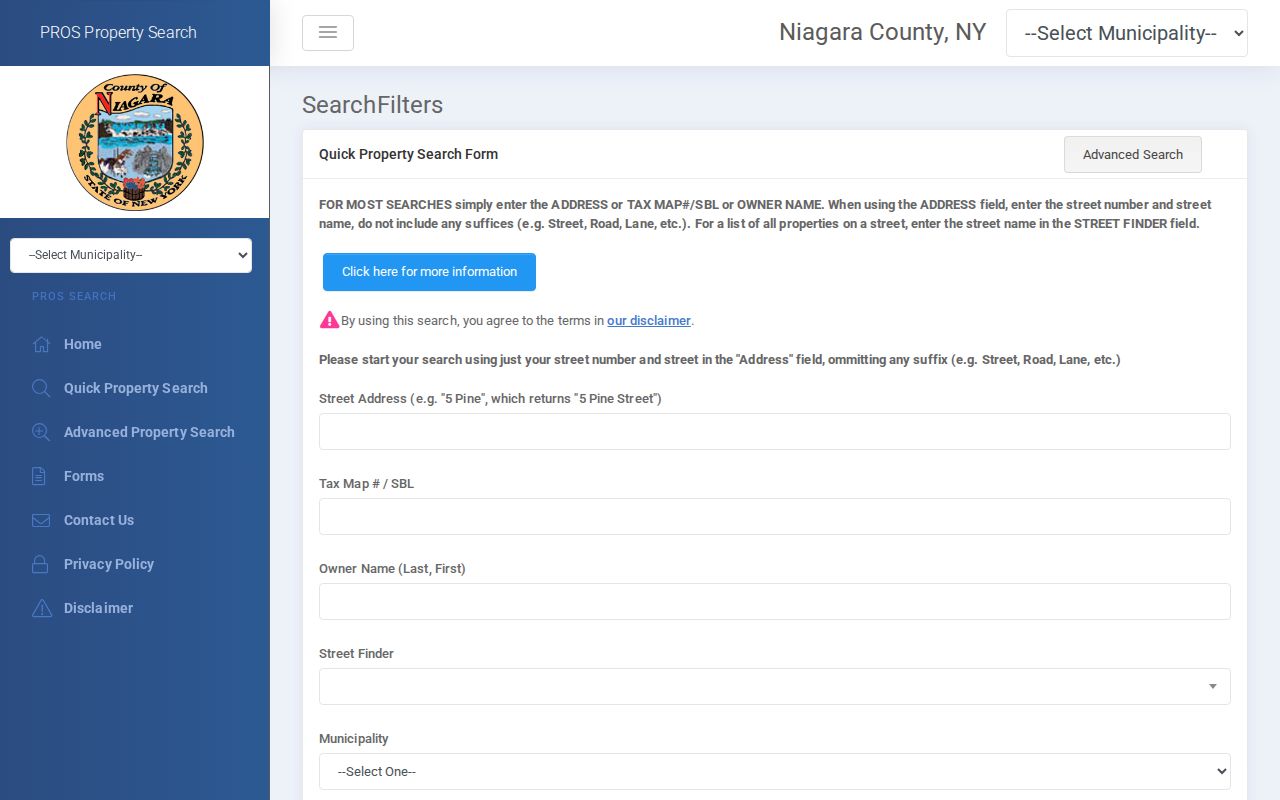
Street Finder and Municipality are especially useful when a broad address query returns more than one parcel.
The PROS advanced-search form exposes the additional property-characteristic and range filters.
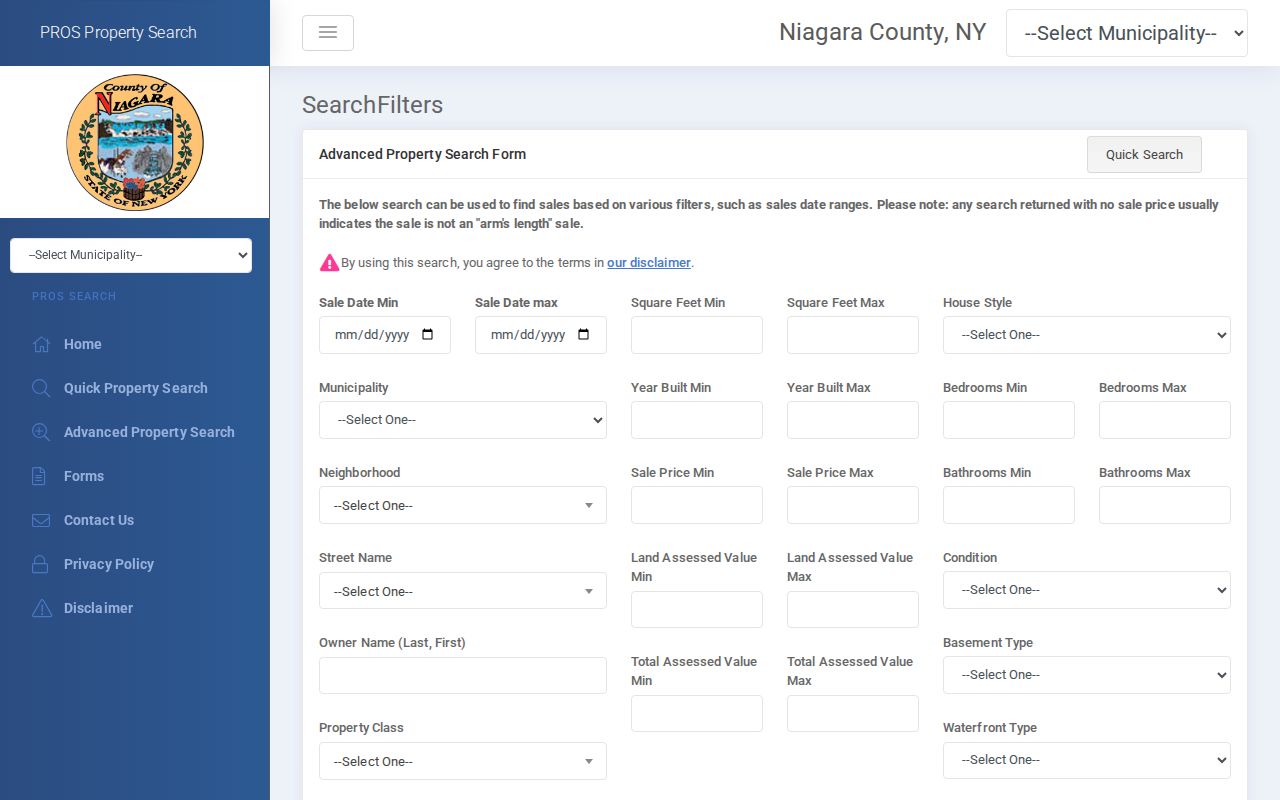
Those filters refine parcel results, but they do not convert the result into a list of current occupants.
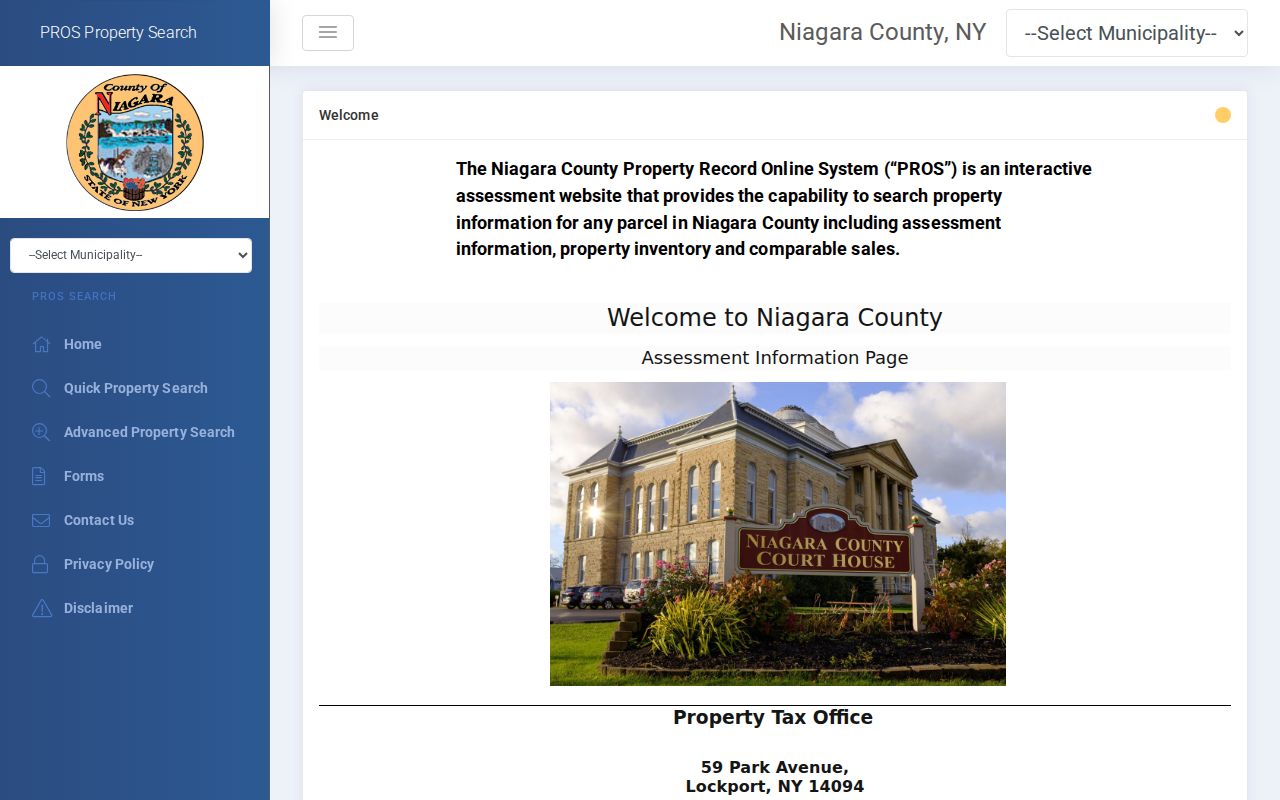
See the county Real Property page before beginning a parcel search. The screenshot shows the county’s entry point for assessment, property-inventory, comparable-sales, and parcel information.
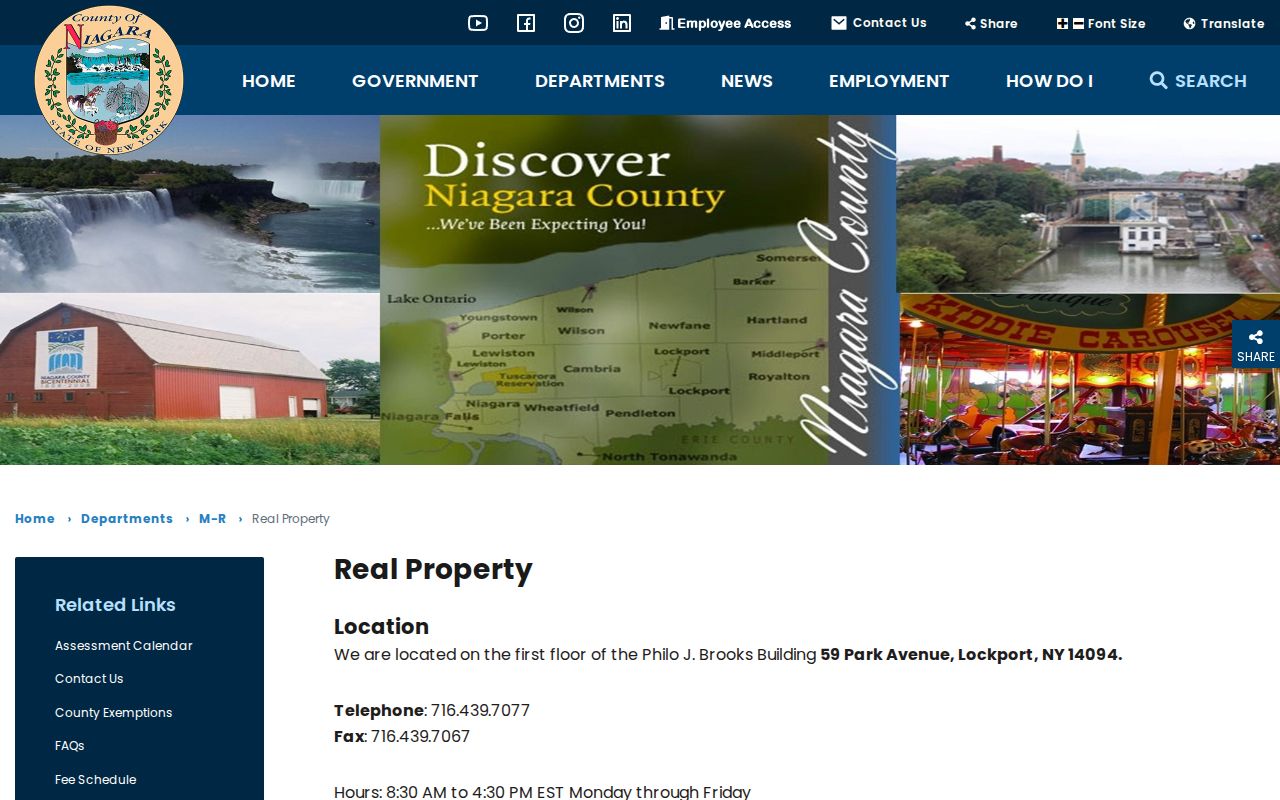
That starting screen leads to the field-specific search choices, so it is useful for recording which query was used and when.
Niagara County Parcel Records
The PROS-GAR parcel system places assessment fields beside the parcel identifiers needed for a later Clerk request. A card can show the owner name and correspondence address, prior owner, sale history, deed book/page reference, property description, land and improvement tables, assessments, map controls, and SBL/SWIS. Its owner field is an assessment record. It is not evidence that the listed owner is physically present at the situs.
The inspected PROS parcel-card view illustrates the kinds of fields a card may provide, including ownership, sale, assessment, and map details.
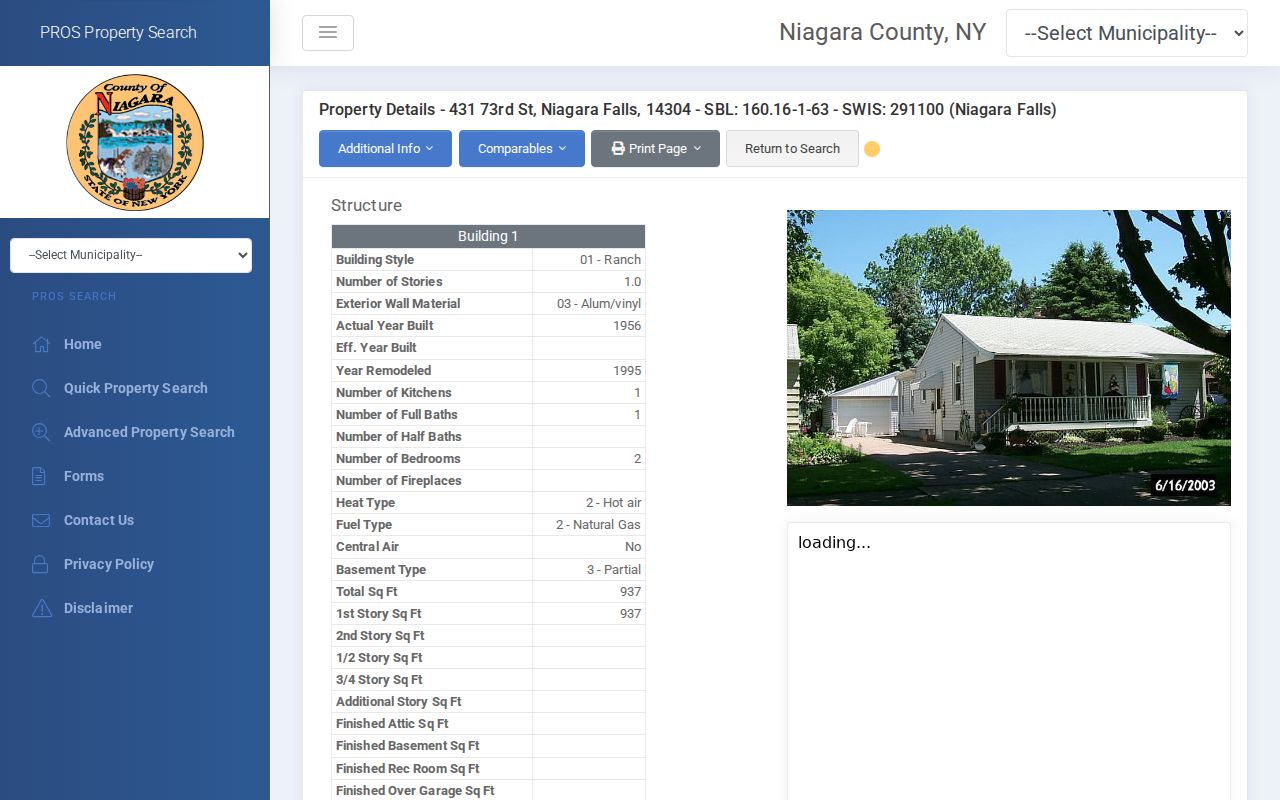
Use the live parcel’s own identifiers, not the displayed sample, when tracing a specific Niagara County street address.
The PROS-GAR home screen also links to parcel search and related real-property tools.
Once a result is selected, copy the SBL/SWIS and deed reference before moving between systems.
Niagara County Street GIS
Niagara County’s ArcGIS Viewer adds a map view to the parcel search. It accepts owner name, address, or SBL and offers matching suggestions while text is entered. Parcel, road, zoning, and other layers can be toggled; a grey layer may simply require more zoom. Click an active parcel layer to open its popup, and use the arrows when several layers occupy the same point.
The map supports Measure, Draw, Bookmark, Add Data, and Select. Those tools describe geography, not people. A useful street record note identifies the street segment, the selected parcel or area, the date, and the active layer settings. External layers added through the viewer should remain clearly separate from county records.
Niagara County Street 300-Unit Radius
The GIS user guide describes a Public Notification tool that starts with an address or SBL and applies a default 300-unit distance. The distance can be changed in feet or meters, or the searcher can draw a point, line, polygon, or custom area. That makes the tool useful for a defined parcel-area question, not for guessing social relationships along a street.
The guide says its output is land-owner information and mailing address. Both the parcel database query and attribute export have a 1,000-record maximum. A mailing address can be elsewhere, so the exported result must be described as an owner mailing list, never as proof that each person occupies a property in the selected area.
Niagara County Street Records
Different custodians keep different parts of the address record. Keep the SBL, SWIS, legal description, and recording reference together so a record can be checked by the office that created it. The table separates what each source can actually show from information that would need another source.
| Addressed record | Custodian | What it can show | Access route |
|---|---|---|---|
| Assessment parcel card | County Real Property or municipal assessor | Owner field, mailing address, situs, SBL, physical attributes, value, sale/deed reference | PROS; local assessor for corrections |
| Parcel and map layers | County GIS | Parcel geometry, layers, selected ownership and mailing output | ArcGIS Viewer and its guide |
| Recorded deed or map | Niagara County Clerk | Parties, legal description, recording date, book/page or instrument | SearchIQS if available, otherwise Clerk request |
| Historical directory | Libraries, Historian, and archives | Dated address, street section, household or business snapshot when the volume contains it | Film, print, mediated lookup, or authorized collection |
| Permit or code file | City, town, or village building/code office | Address-keyed work or violation history if released | Ask the correct municipality; no countywide portal was confirmed |
A municipality remains the likely authority for local street names, building addresses, emergency-address questions, and locally held permit or code records. No countywide official list of street renumbering or renaming was found. Confirm a particular street’s history with its municipality before stating that an old and new address are equivalent.
Niagara County Owner Records
A parcel card’s situs is the physical parcel location. Its mailing address is where an owner or record recipient receives correspondence. Either can differ from the address a reader expects. The record can name an estate, trust, corporation, representative, or several owners. A map result and an assessment owner field therefore cannot establish who is currently inside a building or identify every member of a household.
Utility customer information and restricted DMV address data are not public sources for this method. An address result is strongest when it is described by record type and date: for example, an assessment owner field, a recorded deed party, or a historical directory entry. It should not be stretched into a statement of current presence.
Niagara County Deed Records
SearchIQS is the county’s online landing page for recorded-instrument searching, subject to login, subscription, and series coverage. It answers a different question from PROS: a parcel card can point to a sale or deed reference, while the Clerk’s index and copy process concern the recorded instrument. Neither resource alone is a title opinion.
Use the parcel card’s purchase reference to find or request the deed, identify the seller as grantor and the legal description, then search that earlier party as a grantee to work back. If an address is written differently in a historical document, follow the SBL, lot/subdivision description, parcel map, and legal description rather than street text alone.
There is a material coverage conflict. An official SearchIQS index document described deed coverage as circa 1941, while the SearchIQS help material states circa 1918. The County Legislature’s 2020 plan to convert 1918–1940 grantor/grantee and deed volumes was a plan, not confirmation that every image is now online. Confirm the usable cutoff with the County Clerk before treating an online absence as a missing deed.
Niagara County Clerk Records
The Niagara County Clerk accepts requests for deeds, mortgages, maps, and related land records by phone, email, mail, or in person. Give the office the names, recording date, and book/page or instrument number when known. Those details distinguish the desired document from a similar entry and may be necessary for fulfillment.
Ask for the product needed: an index result, plain copy, certified copy, map, or underlying image. Searchable index data and viewable images have different availability. When SearchIQS does not provide the needed earlier material, the Clerk’s physical volumes, FamilySearch catalog material, microfilm, the County Historian, and local repositories form the fallback network.
Niagara County Street History
Older printed directories can place a name at an address only for the issue and section actually consulted. New York State Library holdings record Lockport runs beginning in 1856–57 and list an uneven countywide run beginning in 1869. Lockport Public Library holds city directories, newspapers, census microfilm, and selected obituary indexes; the County Historian describes directories from 1856 alongside local files.
A separately cataloged Niagara criss-cross or reverse-directory run was not confirmed. Conventional directory street sections may be useful when the volume has them. Ask the library or Historian whether a reverse directory, telephone book, map, or local address index covers the target year rather than assuming it does. The same caution applies to Sanborn or fire-insurance maps: exact local coverage was not confirmed in the inspected sources.
Niagara County Street Directory Terms
These terms help keep a street lookup attached to the type of record that produced it.
- Parcel
- A mapped unit of land used in assessment and tax-map work. The SBL and SWIS help identify it across county parcel records.
- Situs address
- The physical location used by assessment and GIS systems. It can differ from the owner’s mailing address.
- Plat
- A filed subdivision map that can help connect lots and street layout. Confirm with the County Clerk whether a plat or map exists for the specific parcel.
- Criss-cross directory
- An address-to-name directory. A separate Niagara run was not confirmed; ask a repository about coverage for the year at issue.
Niagara County Street Result Limits
Street information is fragmented by design. Public assessment data is not a complete occupant list, a whole-street GIS result is a parcel result set, and a historical directory is not current evidence. Even a deed trail documents recorded transactions rather than a complete story of who lived at an address. Keep the source date and field label beside each note, and ask the responsible custodian to correct a record that appears wrong.
Lawful use. Niagara County street records are for personal, lawful address and family-history research. Do not use names, maps, or recorded documents to stalk, harass, intimidate, or harm anyone.